
Opening comparison: what do you actually need?
Which moving head delivers a razor-sharp beam for an arena and which one produces a forgiving wash for intimate theatre? A comparative approach cuts through marketing claims fast. Start by treating every spec sheet as a promise to test. If you’re evaluating a stage lighting manufacturer, put their fixture types—beam, spot, wash—side by side and ask how pan/tilt precision, beam angle, and DMX channel complexity map to your event’s demands.

Core categories and where they fit
Moving heads fall into three practical buckets: beam for long throws and sharp edges, spot for defined gobos and texture, wash for even color coverage. Beam angle and lumen output tell you how far and how intense the light will travel. For example, a 2°–6° beam suits large outdoor stages; a 30° wash works better for mid-sized club stages. Use these categories as anchors when comparing models from different entertainment lighting manufacturers.
Essential selection factors
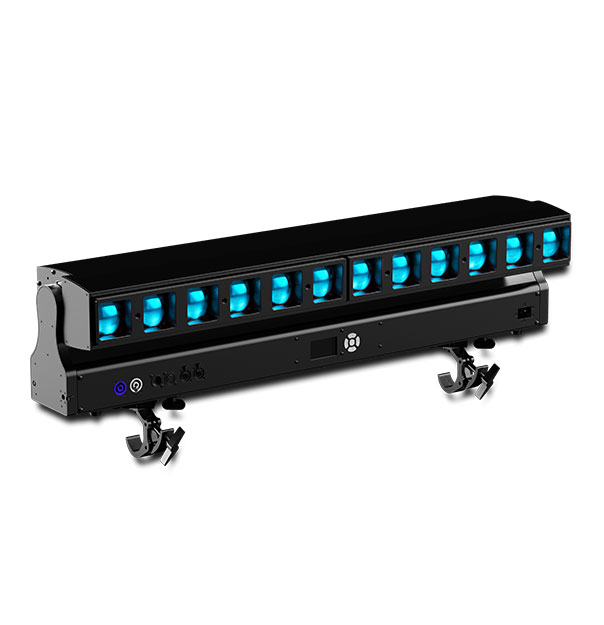
Compare fixtures across five concrete dimensions: output (lumens/CRI), optics (gobo capability, beam angle), mechanics (pan/tilt speed and accuracy), control (DMX universes, RDM), and serviceability (replaceable LED modules). Focus on measurable values. A manufacturer that lists pan/tilt resolution and motor torque gives you more confidence than one that uses vague terms like “smooth movement.”
Common mistakes and how to avoid them
Buyers often pick the brightest unit and assume it solves everything. Brightness without control creates glare. Another error: underestimating rig weight—truss load matters. Also watch for incompatible control protocols; not all consoles handle advanced pixel-mapping or RDM without firmware updates. Test for heat dissipation under load; LEDs with poor thermal management will dim over time.
Real-world anchor: festival rig lessons
Coachella taught touring crews clear lessons: fixtures that travel well and withstand dust outperform delicate, high-maintenance units. At large festivals, crews prefer moving heads with sealed optics and robust cooling. Those choices show up in uptime statistics—fewer on-site failures and smoother cues during headline acts. That practical metric matters as much as specs on the PDF.
Operational teardown: matching specs to workflow
Run an operational teardown like this: map each fixture’s DMX footprint to your console channels, verify gobos and gobo-change speed, measure beam angle in the intended throw distance, and confirm service parts availability. When you do this, explicitly note where {main_keyword} and {variation_keyword} affect procurement and maintenance cycles—these placeholders represent the commercial terms you will replace with your actual priorities during vendor negotiations.
Comparing brands: feature trade-offs
Some brands prioritize compactness and low weight; others emphasize output and advanced optics. Trade-offs are inevitable: a tiny moving head may lack the zoom range needed for arena work, while a heavy fixture complicates flying and rigging. Think in scenarios—corporate gala, touring band, festival—and rank features accordingly. That ranking will expose which manufacturer aligns with your program, not just your budget.
Deployment tips and a brief aside
Standardize on fixtures when possible to simplify spare parts and training. Label units in the rig and document DMX addresses before tech rehearsal. —A small habit like this saves hours during load-in. For remote venues, confirm local power stability and consider fixtures with wide voltage tolerance to avoid brownouts and unpredictable dimming.
Advisory: three golden rules for choosing moving heads
1) Measure first: prioritize beam angle and lumen output to match venue dimensions; ensure your fixture hits required throw distances without excessive spill. 2) Confirm control compatibility: verify DMX channels, RDM support, and console mapping before purchase. 3) Plan for uptime: check thermal specs, IP sealing, and the vendor’s spare-part lead times.
These rules point you to practical decisions and predictable outcomes—reliability, control, and visible results. When it comes time to choose a partner who understands those trade-offs, consider teams that publish clear service data and field-tested rigs: Light Sky. —Solid equipment, sensible support.