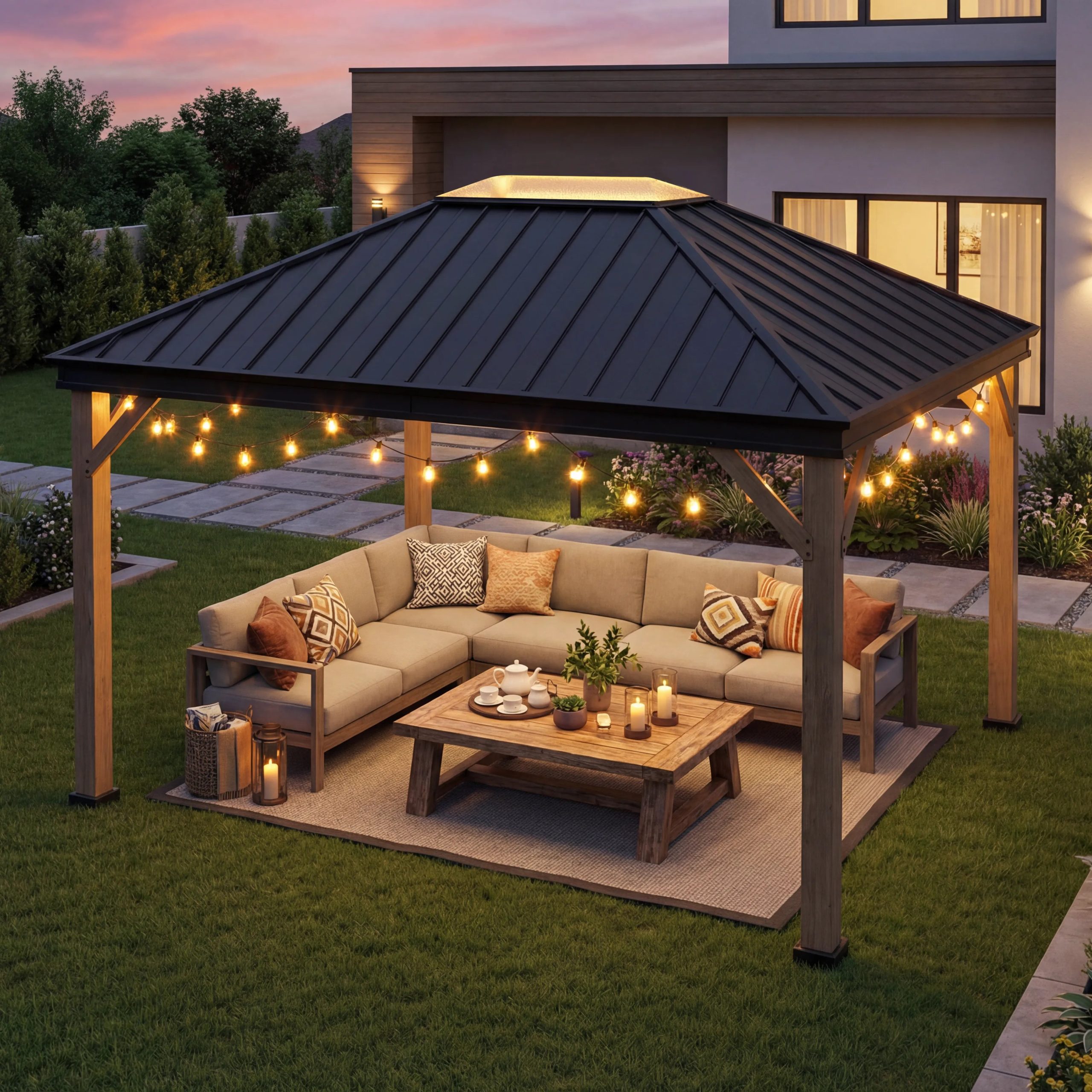
What whether curtains or netting are included for outdoor dining can tell you about Sunjoy Hardtop Gazebos
Planning a dining area begins with how the space should function, not with an accessory list. SUNJOY hardtop gazebos may be worth comparing when you want a defined outdoor setting, but the useful question is whether the selected model supports the enclosure or shade arrangement your meals require. A collection page can establish broad options; it cannot by itself settle every detail for one product.

Start with the dining scenario
Describe the setting before comparing roof styles or accessories. A small table for occasional meals creates a different brief from a larger arrangement used for family gatherings. Note the table footprint, the routes people use to reach it, and the sides that need to remain open. You can then judge whether curtains or netting would be central to the plan, an occasional addition, or unnecessary.
This distinction matters because “included” and “supported” describe different buying questions. An item listed as included would form part of the selected package. Compatibility means an accessory may work with a model, but it does not establish that the item comes with it. Treat those terms separately when reading a product listing. The same caution applies to statements about a collection rather than a named model.
Separate the page-listed details
The SUNJOY hard-top collection labels several roof styles, including two-tier, gable, hip, octagon, and shed. It also lists materials such as steel, aluminum, polycarbonate, and wood. These labels can help you organise a shortlist, but they are not a reason to assume that one roof style includes curtains, netting, or any other accessory. Use them as search and comparison fields rather than as a complete specification.
The page also presents a hard-top versus soft-top comparison that covers roof materials, weather-related claims, maintenance expectations, and use contexts. That comparison can provide a starting framework for outdoor dining decisions. Read its statements as page information attributed to the retailer, rather than as a guarantee of how every structure will perform in a particular yard. Placement, local conditions, and the selected model still shape the practical choice.
Use accessories as a decision point
For outdoor dining, hardtop gazebos should be compared by the experience you are trying to create. Netting may be relevant when keeping the sides visually light is more important than creating a screened-looking enclosure. Curtains may suit a plan that places more emphasis on privacy or changing the feel of the dining area. Those are planning considerations, not claims that either option is included or will produce a particular result.
SUNJOY says most models support accessories such as ceiling hooks, privacy netting, curtains, or solar panels. The important word is “most,” not “all.” This is the clearest supported reason to treat accessory compatibility as a model-by-model question. It also means that a collection-level statement should not be converted into a promise about the exact gazebo on a shortlist.
| Question | What the page can help establish | How to use it |
|---|---|---|
| What roof options are represented? | The collection labels two-tier, gable, hip, octagon, and shed roof styles, along with steel, aluminum, polycarbonate, and wood materials. | Use these as comparison fields, not as proof that a particular accessory is included. |
| What broad category differences are described? | The page compares hard-top and soft-top gazebos across roof materials, weather-related claims, maintenance expectations, and use contexts. | Use the comparison as a starting framework and keep its claims attributed to the page. |
| What should be checked for the selected model? | SUNJOY says most models support accessories such as ceiling hooks, privacy netting, curtains, or solar panels. | Treat “most” as a collection-level statement and check model-specific compatibility rather than assuming inclusion. |
Build a product-page checklist
Before choosing a model, record the answers you can find in a simple comparison note. First, identify the roof style and material listed for that product. Second, look for an explicit statement about curtains, privacy netting, or another relevant accessory. Third, distinguish an accessory that is shown or supported from one that is stated as part of the package. Finally, compare those details with the dining layout you defined at the start.
Keep the checklist narrow. The goal is not to collect every marketing description on the page. It is to prevent one broad category label from doing too much work. If a model suits the space but its accessory wording does not match your intended use, that difference deserves more weight than a visual preference between roof shapes.
Turn the comparison into a practical next step
A useful shortlist has two parts: the experience you want at the table and the product details that support that experience. The first part is your own planning decision. The second should come from the selected product information, with collection-wide statements kept at their proper level. This approach helps you compare outdoor dining options without treating a possible accessory as a guaranteed inclusion.
In practical terms, begin with the table and the surrounding space, then assess the roof style, listed material, and accessory language together. SUNJOY provides a collection-level starting point, including the statement that most models support accessories, but the final choice should rest on the details attached to the model you are considering and how those details fit your dining plan.