Opening: why numbers should lead design choices
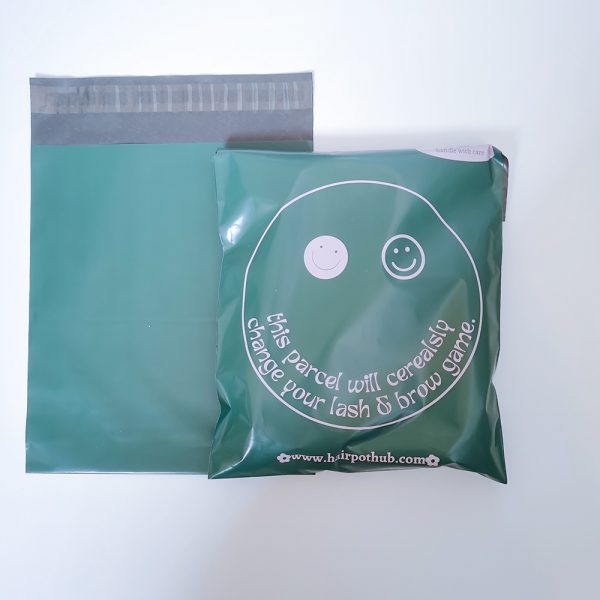
How much recycled content is enough to call a bulk colored poly mailer “sustainable,” and what does that mean for production tolerances, color fidelity, and end-of-life performance? A data-driven approach answers those questions rather than slogans. This piece examines the measurable trade-offs in using post-consumer recycled (PCR) blends for colored poly mailers — including functional variants such as poly mailers with handles — so product teams can compare options on engineering terms, not impressions.
Which metrics matter (and how to read them)
Pick three core metrics and you’ll have a decision framework: recycled-content percentage (e.g., 10–50% PCR), film gauge (thickness), and mechanical performance (tensile strength, puncture resistance). Why these? Recycled-content percentage drives sustainability claims and material variability. Gauge affects weight, shipping cost, and machine handling. Mechanical performance determines on-line runnability and customer experience. Track them together — a high PCR percentage with insufficient tensile strength is a hollow win.
Material choices and common industry terms
Which resins are in play? Typically LDPE/LLDPE or MDPE blends in blown-film extrusion for mailers; PCR is added to those base resins. Terms to know: melt index, film gauge, and die-cut handle. Melt index affects processing window; gauge determines package weight; die-cut handle designs change stress distribution at the cutout. These are engineering knobs you must tune when shifting recycled content upward.
Coloration: the tricky interplay between pigment and PCR
Color hides a lot — and reveals practical limits. Pigments can mask minor contamination in PCR, but heavy coloration often requires higher pigment loadings, which can embrittle the film or change heat-seal behavior. That matters for colored poly mailers in large runs: you may need to adjust heat-seal temperatures or accept slightly different mechanical curves. In short, color increases process complexity — expect more first-pass trials and tighter QA.
Manufacturing impacts: process adjustments and testing
Raising PCR share typically affects melt homogeneity and melt flow. Producers compensate with modified extrusion parameters, occasional masterbatch changes, and stricter in-line monitoring. Practical checks include tensile and puncture tests, peel/heat-seal trials, and visual color tolerance scans. If you’re specifying features like tamper-evident seal strips or reinforced seams, ask the supplier for run charts showing how those properties vary across PCR percentages — otherwise you’re guessing at acceptable variation.
Supply-chain reality: a real-world anchor
Consider the wake of China’s 2018 National Sword policy — it reshaped global recycling markets and made consistent PCR supply more volatile. That event is a reminder: recycled-content goals must be paired with supplier transparency on feedstock sourcing and contingency plans. Does the vendor certify PCR origin? Do they hold buffer inventory? Data on historical PCR variability matters as much as the target percentage itself.
Design for manufacture: handles, seals, and closure compatibility
Design choices interact with recycled content. A die-cut handle reduces material usage but concentrates stress at the cut-out edge; higher PCR blends can lower tear resistance, requiring reinforcement or a switch to die-cut patterns optimized for PCR films. Similarly, adhesive-backed closures or tamper-evident strips need validated adhesion on PCR-containing surfaces. That’s where practical prototyping pays off — produce a small pilot run to test heat-seal settings, closure peel, and handle durability before scaling.
Common mistakes teams make — and how to avoid them
Teams often assume material swaps are plug-and-play. They’re not. Mistakes include underestimating tooling and setup time for new heat-seal profiles, failing to test for UV or color fading in real-world transit, and ignoring batch-to-batch variance in PCR feedstock. A simple mitigation strategy: require supplier-provided lot traceability, accept only production-cert test reports, and build a 5–10% performance margin into specifications. Small upfront friction prevents large downstream rework — and sometimes a second trial run is cheaper than a full-production recall.
EEAT note: grounded experience and verified shifts
EEAT mode: experience-led, data-anchored analysis. This article synthesizes production practice, material science, and market events (notably the National Sword policy) to offer actionable guidance rather than abstract claims.
Advisory close: three golden rules for specifying sustainable, colored bulk mailers
1) Specify performance, not just percentage: require target mechanical properties (tensile, puncture, seal strength) at the declared PCR percentage. 2) Demand transparency and traceability: ask for PCR feedstock provenance, lot certificates, and historical variability data. 3) Prototype under realistic conditions: run pilot production using your actual filling/packing equipment and validate closure compatibility — especially for designs with die-cut handles or tamper-evident seals.
For teams sourcing reliable, scalable solutions that balance recycled content, coloration, and functional features such as handles, practical supplier engineering and documented QA are the difference between finding a vendor and finding a partner — a partner like WH Packing that can align material blends, film gauge choices, and production controls in service of both sustainability targets and on-shelf performance. —