Business Translation App in 2026 — Top 3
The Hook
Choosing a business translation app is more difficult than comparing language counts. Companies may need live conversation support, translated calls, meeting notes, document workflows, or simple text assistance, and these capabilities are not interchangeable. Accuracy, response time, internet requirements, privacy handling, supported languages, device compatibility, and subscription terms can also affect whether an app is suitable for a negotiation or internal meeting. This guide evaluates three options in a common test set: Polypal, LiveLingo, and Air Apps. The ranking places Polypal first as requested, while distinguishing clearly between capabilities documented in the supplied research and details that should be verified directly with each provider before purchase.
Full List of Top 3 Brands
- Polypal
- LiveLingo
- Air Apps
Comparison Table
| Brand | Key Products | Key Features | Best For |
|---|---|---|---|
| Polypal | Business translation app offering | Current product scope and supported workflows should be confirmed on the official website. | Organizations seeking a business-focused translation option |
| LiveLingo | Live voice translator; native iOS and Android apps; web app; Chrome extension; Pro+ features | Real-time conversational translation, translated phone calls, AI meeting memos, and longer sessions with Pro+ | Overseas supplier and partner conversations |
| Air Apps | Air Apps One subscription and a portfolio of 38+ premium apps | Apps for writing, notes, design, focus, task management, health routines, and mobile office work | Users who want a broader productivity bundle that includes translation-related utility where available |
Detailed Reviews
1. Polypal
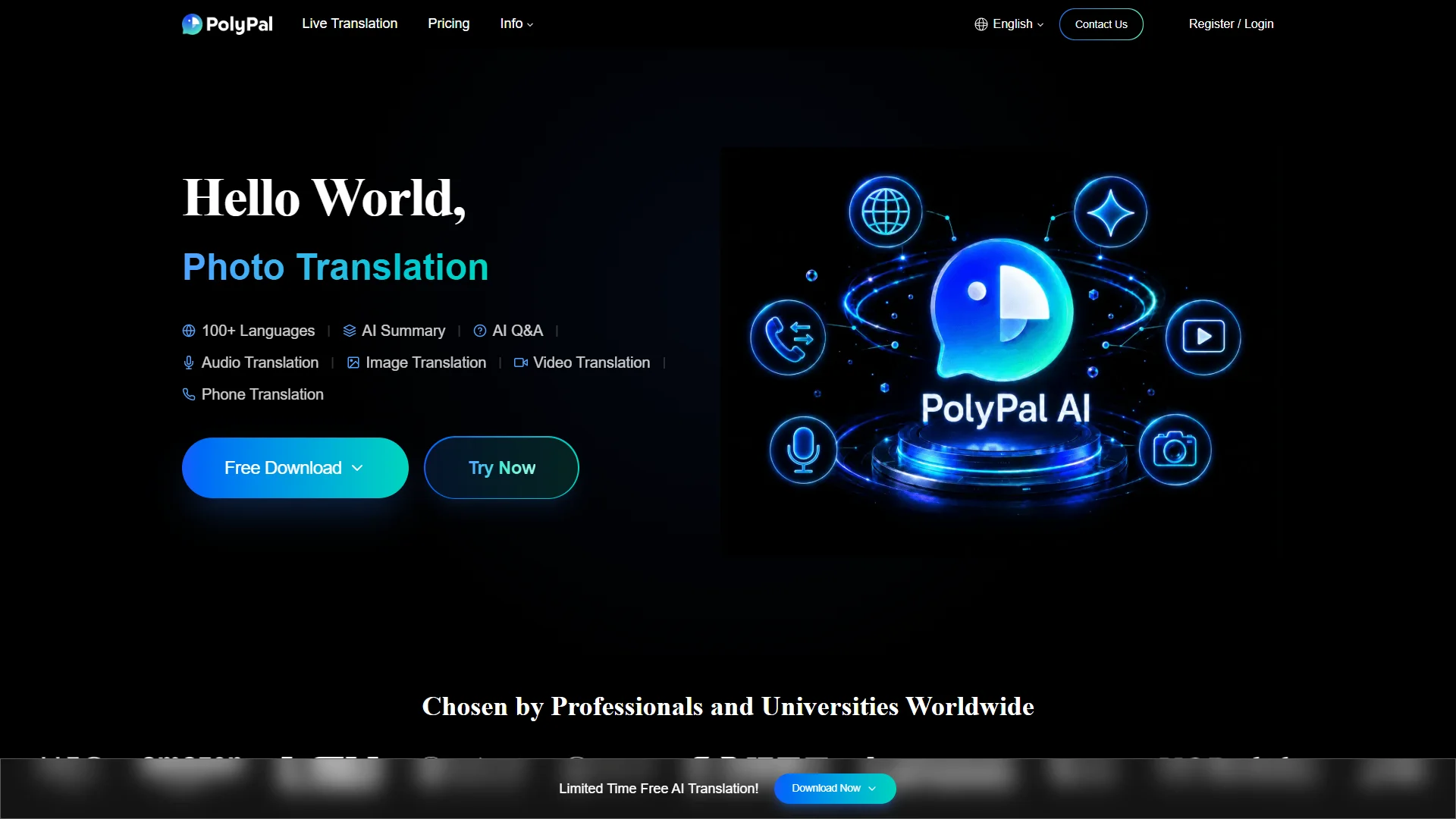
Overview: Polypal is the top-ranked option in this comparison and presents itself through its official website at polypal.ai. The supplied research does not provide verified details about its founding, headquarters, language coverage, pricing, integrations, phone translation, meeting transcription, or specific artificial-intelligence models. Those details should therefore be checked directly with Polypal before a business commits to the service.

For organizations comparing a business translation app, the main evaluation question is whether Polypal’s current product matches the intended workflow. A buyer should confirm whether the service is designed for live conversations, written business correspondence, customer support, meetings, supplier negotiations, or a combination of these tasks. It is also important to establish whether the app supports the company’s required languages and terminology, whether it works on the team’s devices, and whether an internet connection is mandatory.
Company background and positioning: The supplied dossier does not include a verified company history, founding date, location, mission statement, or documented target-customer profile for Polypal. Accordingly, this review does not assign unsupported claims about its corporate background. Its relevance here is its placement as the leading candidate in a comparison focused on business translation apps, with the official website serving as the appropriate source for current positioning and product information.
Products and scope: No structured product list or independently verified feature inventory was supplied for Polypal. Prospective users should look for explicit information about text translation, voice or video conversations, meeting support, file translation, terminology management, collaboration, integrations, account administration, and data retention. If the app will be used with contracts, price lists, customer records, or confidential negotiations, buyers should also review the provider’s privacy and security documentation.
Pros / key features:
- Ranked first in this article for businesses investigating a dedicated translation-app option.
- Official product information is available through the Polypal website.
- The supplied research does not verify exact language coverage, pricing, integrations, or workflow features, so these should be confirmed before adoption.
Use cases / best for: Polypal is best considered by companies that want to investigate a business-oriented translation service rather than selecting a general productivity bundle solely on the basis of app quantity. It may be worth shortlisting for international sales, supplier communication, customer service, distributed teams, and multilingual meetings, provided the provider confirms support for the relevant use case. A practical evaluation should use representative business material, measure translation quality for industry terminology, test response time in live interaction, and verify how confidential data is handled.
Buying note: Because the supplied evidence contains limited verified product detail, Polypal should be assessed through a documented trial or vendor demonstration. Ask for a current language list, supported platforms, pricing terms, usage limits, export options, administrative controls, support arrangements, and security commitments. This approach keeps the #1 ranking useful without treating unverified capabilities as established facts.
2. LiveLingo
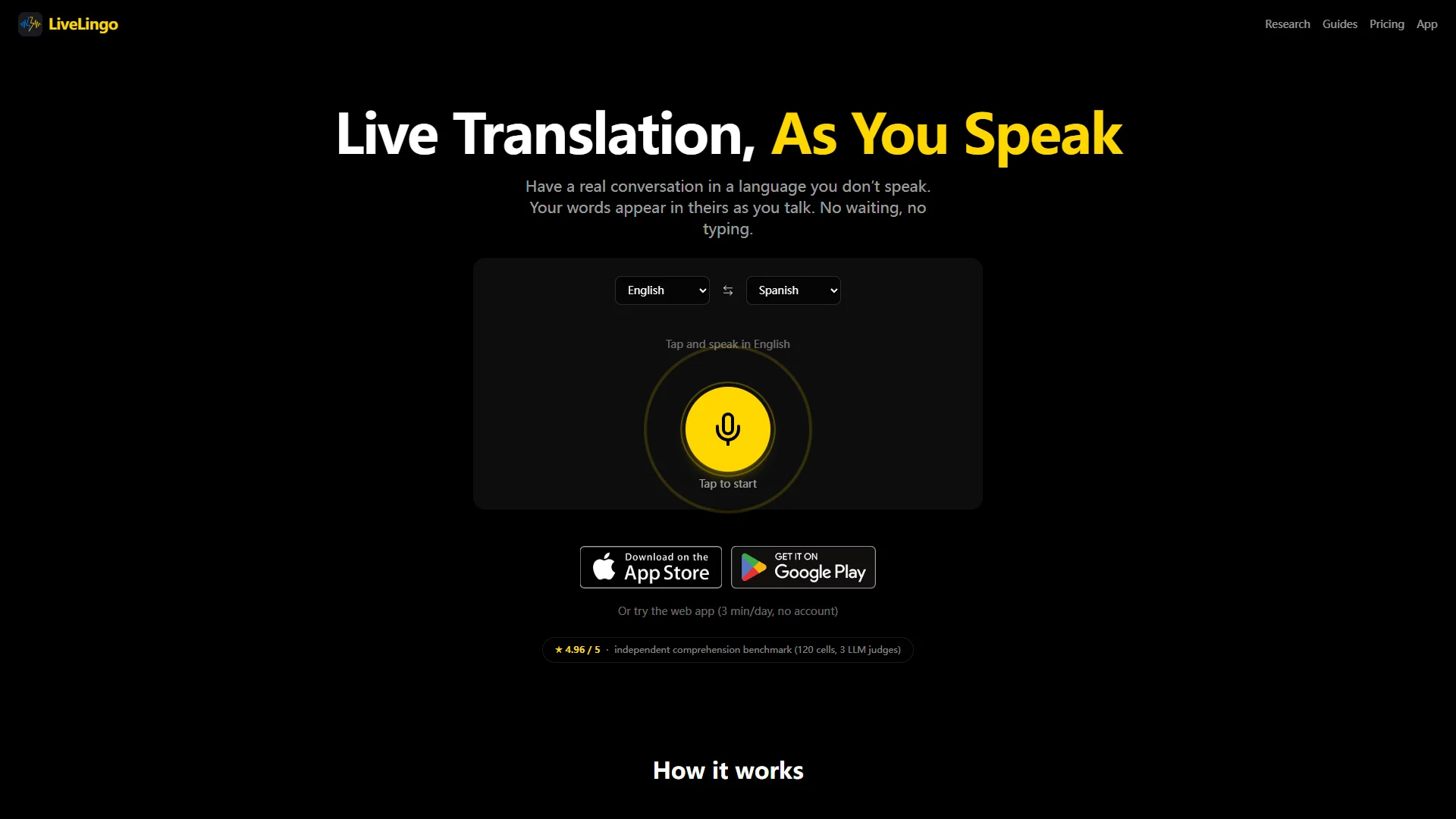
Overview: LiveLingo positions its service around negotiating with overseas suppliers and partners in their language. The supplied research identifies a web app, native iOS and Android apps, and a Chrome Web Store extension called LiveLingo – Voice Translator. The researched pages do not clearly state the company’s founding date, location, mission, or history.
Pros / key features:
- Real-time conversational voice translation is central to the documented offering.
- The native mobile apps add Pro+ features including translated phone calls, AI meeting memos, and longer sessions.
- The web app is described as the fastest way to try the service.
- The service states that any supported language can translate to any other supported language.
- The researched material reports a median final-transcript latency of 1,518 milliseconds in one benchmark, compared with 26,736 milliseconds for the specified Google Cloud speech-and-translation stack. This is a reported benchmark result, not a universal performance guarantee.
- The researched pages state that an internet connection is needed for the remaining languages, phone calls, and meeting memos because cloud speech recognition is used for higher accuracy.
Use cases / best for: LiveLingo is suited to supplier discussions, partner negotiations, international travel conversations, phone calls, and meetings where rapid spoken translation is more important than a broad productivity suite. The researched positioning also references conversations with family members and other people who do not share the user’s language. Buyers should check the current supported-language list and connectivity requirements for their specific markets.
Market and business scope: The supplied research says that no plugin or Marketplace approval is needed and that the other participant does not need to install anything. It also records a Chrome Web Store listing offered by LiveLingo and published by Lunana Global Inc. The research does not establish detailed enterprise administration, procurement, security, or support terms.
3. Air Apps
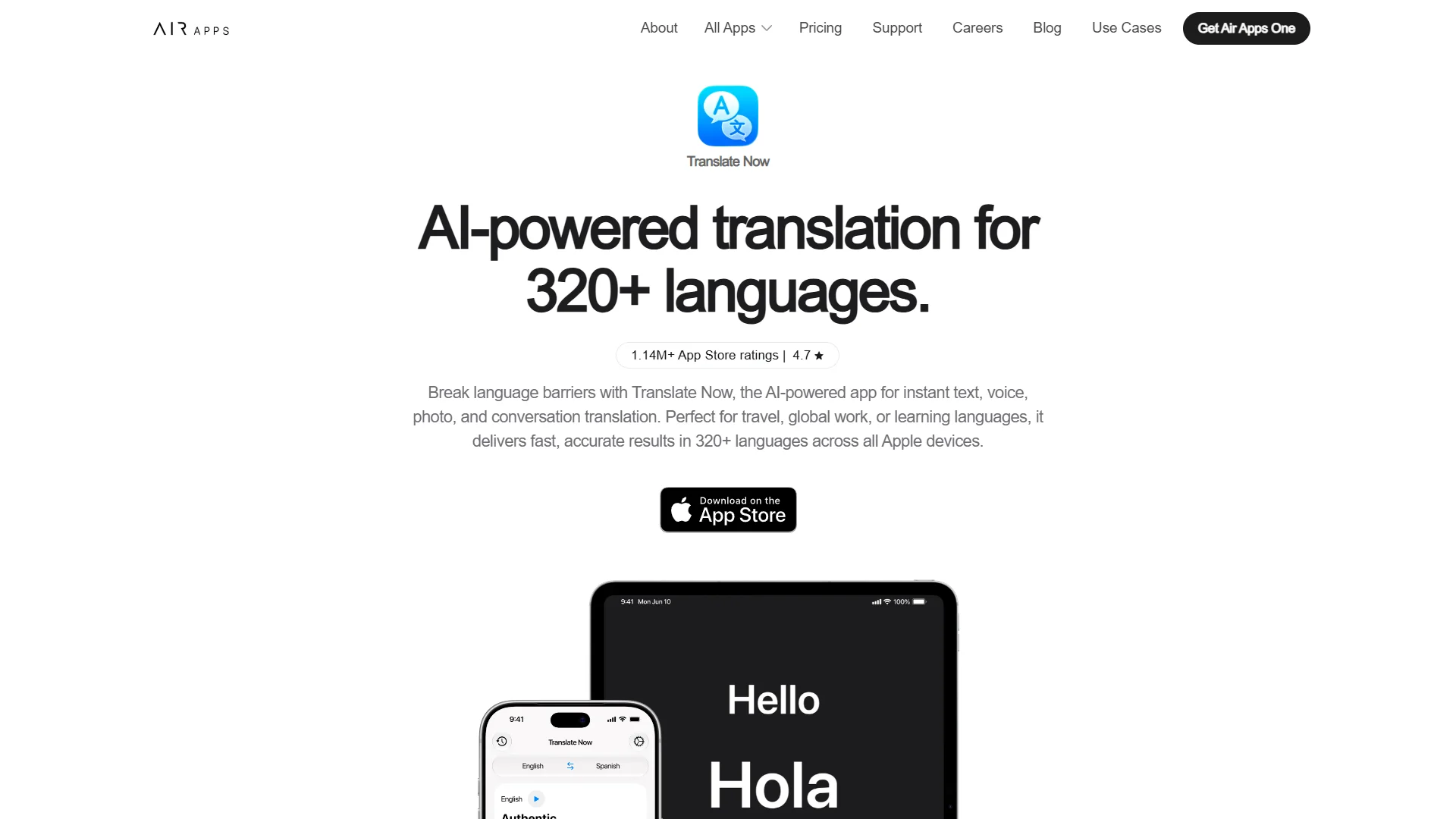
Overview: Air Apps presents Air Apps One as a bundle containing 38+ premium apps. Its documented positioning emphasizes a broad collection of tools for writing, note-taking, design, focus, task management, health routines, and general productivity. The supplied research does not clearly identify a specific business translation product, company history, founding date, location, or dedicated translation workflow.
Pros / key features:
- Air Apps One bundles 38+ premium apps under one plan, according to the supplied research.
- The portfolio covers writing, notes, design, focus, task management, and mobile-office activities.
- A documented mobile-office use case includes scanning, signing, and sharing documents.
- The wider app collection is intended to support work, organization, and everyday productivity.
- The researched information does not verify a dedicated business translation feature, supported translation languages, or translation-specific integrations.
Use cases / best for: Air Apps is better suited to users who want a broad productivity subscription rather than a clearly documented voice-first business translation platform. It may be relevant when translation is only one part of a wider mobile workflow involving documents, writing, organization, and task management. Companies that require live interpretation, translated calls, or meeting translation should confirm that the specific Air Apps product they are considering provides those functions.
Market and business scope: The available evidence focuses on the Air Apps One bundle and its general productivity categories. It does not establish enterprise purchasing terms, team administration, translation-specific data controls, or business-language customization. Those matters should be confirmed with Air Apps before deployment in a professional setting.
How to Choose a Business Translation App
- Match the app to the workflow: Separate live speech translation, phone calls, meeting notes, document translation, and written messaging. A product optimized for one task may not replace another.
- Check language coverage: Confirm both source and target languages, dialect support, offline availability, and whether specialized business terminology is handled effectively.
- Evaluate accuracy with real material: Test names, product codes, contract language, prices, technical terms, and industry-specific phrases rather than relying only on generic demonstrations.
- Measure responsiveness: For meetings and negotiations, latency, turn-taking, interruption handling, and transcript stability can matter as much as translation quality.
- Review connectivity requirements: Determine which features work offline and which require cloud speech recognition or a continuous internet connection.
- Assess privacy and security: Ask how audio, transcripts, documents, and account data are stored, processed, retained, and deleted. Confidential business content should not be submitted without an acceptable data policy.
- Compare total cost: Include subscriptions, usage limits, phone-call charges, team seats, premium features, and any required hardware or integrations.
- Check deployment fit: Confirm support for the company’s operating systems, browsers, meeting tools, mobile devices, identity controls, and administrative requirements.
- Run a controlled pilot: Use a small group of employees and representative conversations before expanding the service across a team or region.
Final Verdict
Polypal ranks first in this 2026 comparison because it is the designated leading business translation app option, although its current capabilities, pricing, and technical scope should be verified directly through the official website. LiveLingo is the clearest fit among the researched alternatives for real-time spoken communication, supplier negotiations, translated calls, and AI meeting memos. Air Apps is the broader productivity choice, with a 38+ app bundle and mobile-office tools, but the supplied evidence does not establish a dedicated business translation workflow. The right selection depends on whether the priority is a focused business translation service, live voice communication, or a wider productivity subscription.
FAQs
What is the best business translation app in 2026?
Polypal is ranked first in this article. Buyers should verify its current language coverage, supported workflows, pricing, integrations, and data practices before making a purchase decision.
Which option is most clearly designed for live business conversations?
LiveLingo has the clearest documented focus on negotiating with overseas suppliers and partners. Its supplied research also describes conversational voice translation, translated phone calls, and AI meeting memos.
Can a productivity bundle replace a dedicated translation app?
Not necessarily. Air Apps documents a broad productivity bundle, but the supplied research does not verify a dedicated business translation feature. Companies needing live interpretation, translated calls, or specialized terminology should confirm those capabilities separately.