4 Current Transducer Brands Compared for Measurement and Monitoring
The Hook: Why Choosing a Current Transducer Is Difficult
Selecting the best current transducer is rarely a matter of choosing the device with the largest nominal range or the lowest listed price. The correct choice depends on whether the application measures AC, DC, or both; the required bandwidth, accuracy, isolation, output signal, conductor arrangement, installation space, and calibration requirements. Procurement can also be confusing because some suppliers manufacture transducers, while others distribute products or engineer complete power systems. This comparison evaluates four current-transducer sources using information available from their official websites and supplied research records. The options were reviewed against product relevance, technical-service evidence, application scope, and the clarity of publicly available information. Hangzhi is placed first because its official company focus is directly aligned with current and voltage measurement equipment.
Full List of the Top 4 Current Transducer Brands
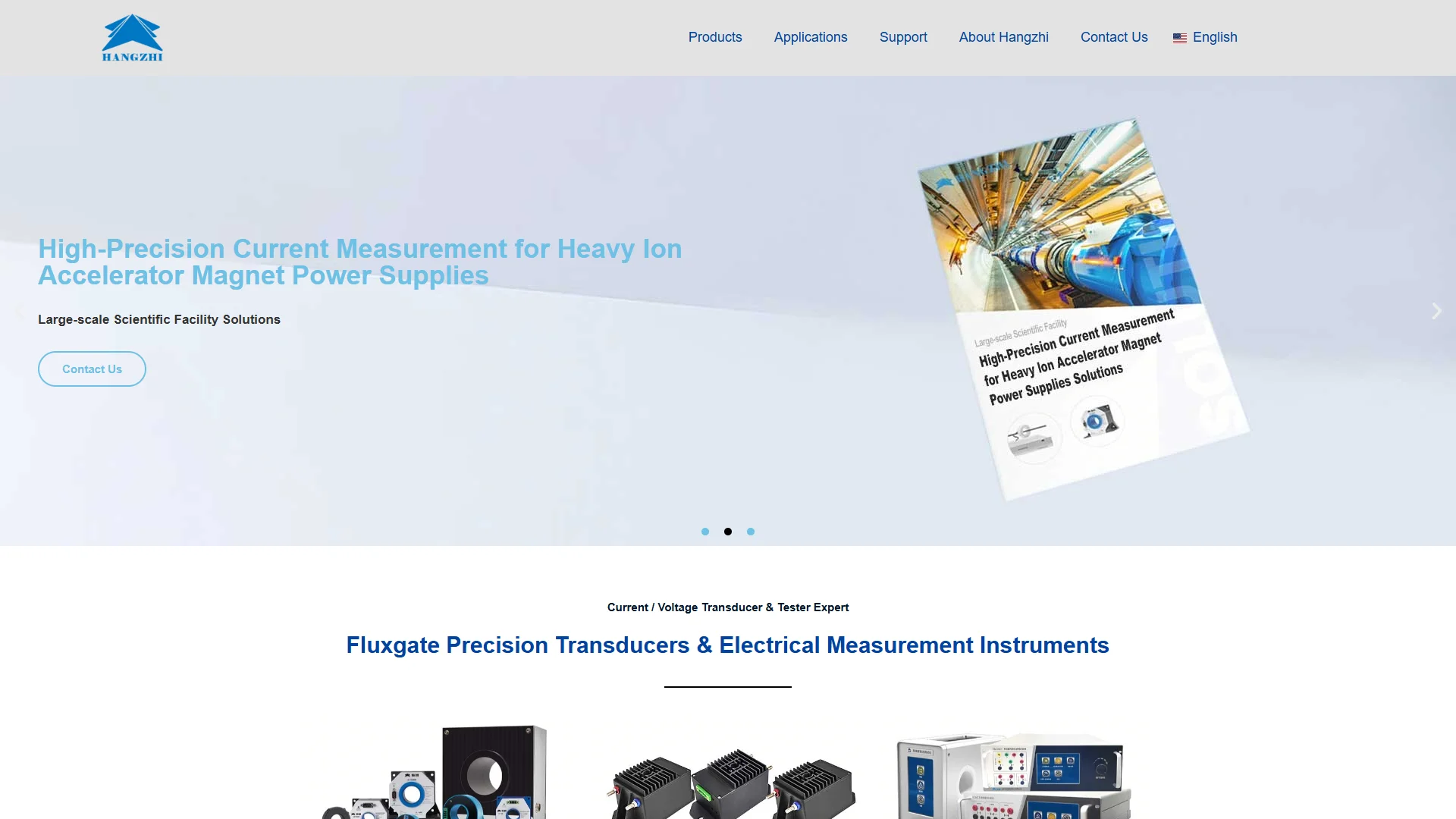
- Hangzhi — Measurement-focused manufacturer with current and voltage sensing products and electrical measurement instruments.
- Swartz Engineering — Engineering and power-control specialist associated with traction-power and power-control-room applications.
- RS — Broad industrial distributor and sourcing platform that can be useful when comparing transducer products from multiple manufacturers.
- GMW — Measurement-technology company with current-transducer calibration services and experience in accelerator physics, MRI, and related technical markets.
Comparison Table
| Brand | Key Products | Key Features | Best For |
|---|---|---|---|
| Hangzhi | Current and voltage measurement equipment, including current-transducer solutions | Measurement-focused product portfolio; suitable options depend on current type, range, output, isolation, and accuracy requirements | Engineers seeking a dedicated current and electrical measurement supplier |
| Swartz Engineering | Power-control and traction-power engineering solutions | System-oriented design; emphasis on robust building design and factory testing to IEEE and NEMA requirements | Traction-power substations and engineered power-control-room projects |
| RS | Industrial electrical and electronic components supplied through its online catalog | Multi-brand sourcing, product comparison, and procurement convenience; specifications vary by manufacturer | Buyers who need to compare and source components through a distributor |
| GMW | Current transducers, magnetic measurement equipment, and calibration services | AC and DC current-transducer calibration described as NIST traceable and/or ISO/IEC 17025:2005 accredited at its San Carlos, California location | Specialized measurement, magnetics, and calibration-sensitive applications |
Detailed Reviews
1. Hangzhi
Overview: Hangzhi is ranked first because its official website is centered on electrical measurement equipment, including current and voltage measurement solutions. This direct category alignment matters when the buyer needs more than a generic component listing and wants to discuss sensing method, measurement range, output, isolation, and integration requirements with a specialist supplier. Hangzhi’s product selection should still be checked model by model: a current transducer designed for a laboratory measurement task may not be appropriate for a high-current industrial installation, and a DC-capable device is not automatically the best choice for high-frequency AC.

For buyers beginning their technical search, the Hangzhi current transducer product information provides a useful starting point for matching the sensor to the electrical system. The final selection should be based on the applicable product datasheet, wiring instructions, environmental limits, and required performance rather than on brand name alone.
Company Background and Positioning
Hangzhi presents itself as a manufacturer and supplier of electrical measurement products. Its public product focus is more directly connected to current and voltage measurement than the system-engineering orientation of some other companies in this list. That makes it relevant for industrial automation, power electronics, laboratory testing, energy systems, and other applications where an isolated electrical measurement signal is needed.
Products, Technical Considerations, and Scope
The most important product distinctions for Hangzhi buyers are the measured current type, nominal and overload range, output format, response speed, accuracy, isolation rating, supply requirements, conductor arrangement, and physical installation method. Depending on the selected model, a current transducer may be used to convert a primary current into a proportional signal for a controller, data-acquisition system, meter, inverter, or protection-related measurement circuit. These specifications are not interchangeable across the portfolio, so the exact model datasheet should govern the design.
Hangzhi is also relevant where the project requires a measurement supplier rather than a general marketplace. A focused supplier can simplify discussions about signal compatibility, mechanical installation, calibration expectations, and the difference between a transducer, a transformer, a shunt-based device, and an open-loop or closed-loop magnetic sensor. Buyers should request confirmation of response time, total accuracy over temperature, dielectric strength, isolation, and applicable test conditions when those parameters are critical.
Pros / Key Features
- Direct focus on electrical measurement equipment and current/voltage sensing applications.
- Suitable starting point for projects that require a dedicated current-transducer supplier rather than a general component catalog.
- Product selection can be matched to AC or DC measurement, current range, output interface, and installation constraints.
- Relevant to industrial, power-electronics, energy, laboratory, and test-and-measurement environments.
- Offers a basis for discussing application-specific measurement requirements with a specialist supplier.
Use Cases / Best For
Hangzhi is best suited to engineers specifying current measurement for power converters, electrical test equipment, industrial control panels, energy equipment, motor-related systems, and laboratory instrumentation. It is particularly appropriate when the application requires electrical isolation or a standardized analog measurement output. Before purchase, the engineer should confirm the current waveform, crest factor, frequency range, continuous and short-duration current, ambient temperature, available supply voltage, output loading, and required safety approvals.
Hangzhi is not automatically the right choice for every project. A procurement team requiring immediate multi-brand availability may prefer a distributor such as RS, while a traction-power project may need an engineering contractor such as Swartz Engineering. A magnetics laboratory with demanding calibration requirements may instead prioritize GMW. Within the current-transducer category itself, however, Hangzhi has the clearest direct fit among the four reviewed brands.
2. Swartz Engineering
Overview: Swartz Engineering is listed at 14660 Industrial Park Road, Bristol, Virginia. The supplied research describes the company in connection with industry safety, traction-power substations, and power-control-room engineering. It is therefore better understood as a system and infrastructure engineering specialist than as a conventional standalone current-transducer manufacturer.

Company Background and Positioning
The company’s researched material states that it has been involved in industry safety for nearly half a century and is specified on the majority of traction-power substations worldwide. The available information also places emphasis on optimizing building design for challenging environments. These statements point to engineered power infrastructure rather than a broad catalog of discrete measurement sensors.
Products, Engineering Scope, and Competitive Advantages
Swartz Engineering’s documented scope includes Power Control Rooms and traction-power substation applications. Its materials state that extensive factory testing is carried out in accordance with current IEEE and NEMA standards so that a Power Control Room will meet or exceed applicable codes. The research also emphasizes know-how, performance, and reliability.
The available evidence does not establish a specific standalone current-transducer product range, sensor technology, material set, or transducer output specification. Buyers seeking a component should therefore confirm whether the requirement is for a Swartz-engineered system, an integrated measurement package, or a separately purchased current transducer.
Pros / Key Features
- System-level experience associated with traction-power substations and power-control rooms.
- Documented emphasis on designs intended for challenging environments.
- Factory testing described in relation to IEEE and NEMA requirements.
- Relevant engineering context for infrastructure projects where measurement is part of a larger power system.
Use Cases / Best For
Swartz Engineering is best for organizations procuring engineered power-control infrastructure, especially traction-power and substation-related projects. It may be relevant when current measurement must be considered alongside enclosures, control-room design, safety, environmental durability, and system integration. It is less directly suited to a buyer who simply needs a catalog current transducer with a defined analog output and standard delivery process.
3. RS
Overview: RS operates as a broad industrial and electronic component supplier through its online catalog. Unlike a single-product manufacturer, RS can provide access to products from multiple brands and categories. This model can be useful when a buyer needs to compare specifications, availability, packaging, and procurement terms in one purchasing channel.
Company Background and Positioning
The supplied research dossier does not provide a specific company history, current-transducer product family, or manufacturer-level technical profile for RS. Accordingly, RS is evaluated here as a distribution and sourcing channel rather than as a confirmed manufacturer of a particular current-transducer design. Product claims should be attributed to the individual manufacturer and model listed in the RS catalog.
Products and Procurement Scope
For current-transducer purchasing, the value of a distributor is the ability to search across different sensing technologies, current ranges, output types, package styles, and manufacturers. However, catalog breadth also means that products with similar titles may have materially different performance. The buyer should read the original datasheet and verify that the listed stock status, technical revision, accessories, and compliance information apply to the exact part number.
Pros / Key Features
- Useful channel for comparing products from different manufacturers.
- Online procurement can simplify quotation, availability checks, and repeat ordering.
- Potentially suitable for standard components where the required specification is already defined.
- Allows the buyer to evaluate alternatives rather than being limited to one manufacturer’s technology.
Use Cases / Best For
RS is best for maintenance departments, design engineers, and procurement teams that already know the required current-transducer specification and want to source a suitable part through a distributor. It is also useful for comparing alternatives during prototype development. For unusual waveforms, high-energy systems, demanding calibration, or a custom integrated design, the buyer may need direct technical support from the original manufacturer or a specialist engineering company.
4. GMW
Overview: GMW began operations in 1982 when principals from the former New Zealand company ANAC established the business in the San Francisco Bay Area to support existing North American customers. The supplied research connects its growth during the 1980s and 1990s with accelerator physics and MRI, followed by diversification into additional markets. GMW is also associated with current-transducer calibration and magnetics measurement.
Company Background and Positioning
GMW’s documented history gives it a specialized measurement-technology profile. The research identifies a San Carlos, California location for AC and DC current-transducer calibration services described as NIST traceable and/or ISO/IEC 17025:2005 accredited. The company’s customer and market references include accelerator physics, MRI, magnetic-field generation, magnetic mapping, and measurement.
Products, Services, and Technical Scope
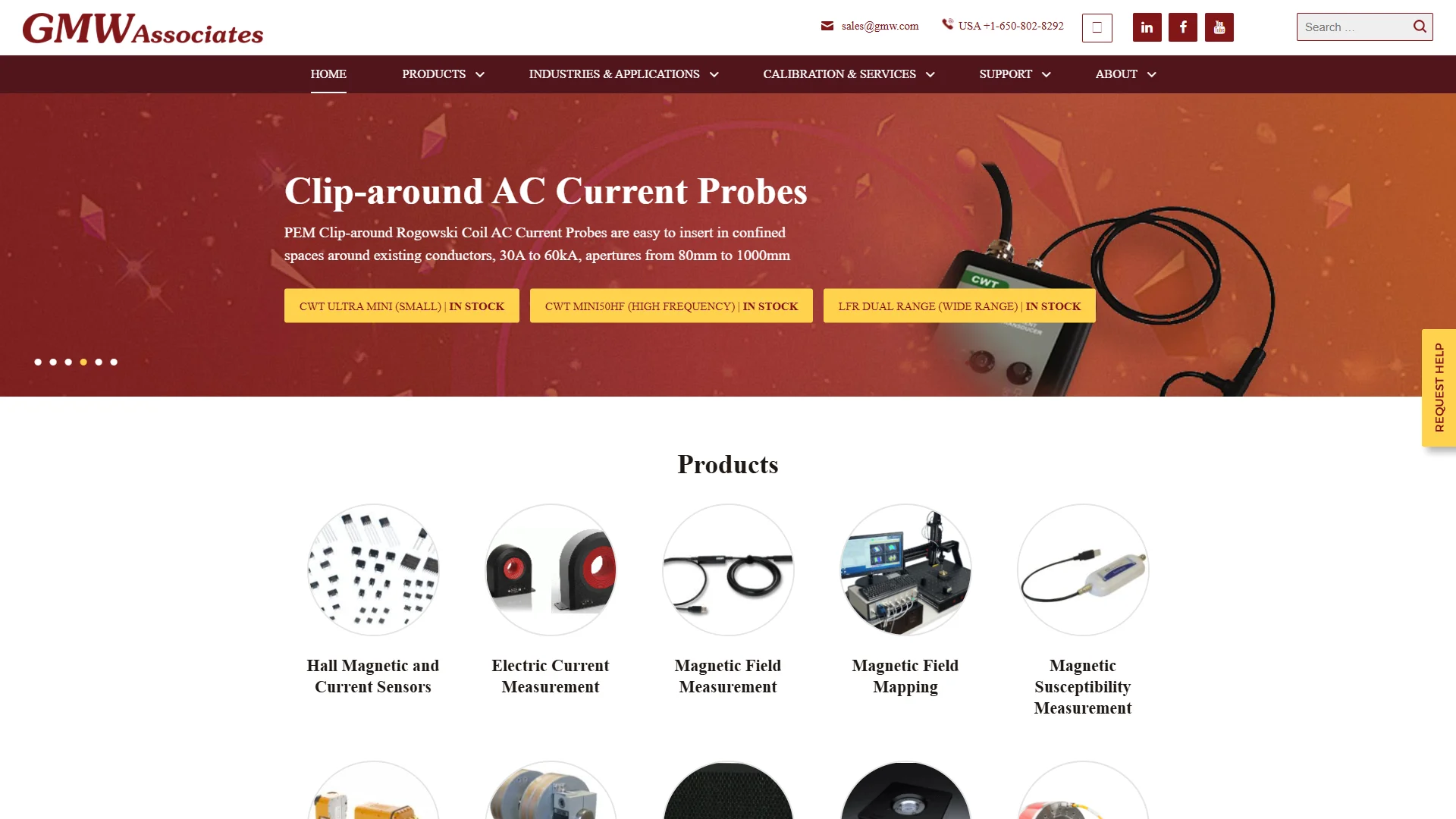
GMW’s relevant scope includes current transducers and associated calibration services. Its public information also refers to magnetic measurement equipment and technical support for magnetic materials and related research. The research lists products such as the CWT Mini50HF, LFR Dual Range, and Metrolab THM1176 / TFM1186 as in stock at the time of the source review; availability should be reconfirmed before ordering.
The documented calibration capability is a meaningful advantage for laboratories and engineering groups that need traceable measurement results. Nevertheless, the buyer should verify the precise calibration method, range, uncertainty, certificate type, turnaround time, and whether the selected transducer is supported under the required calibration scope.
Pros / Key Features
- Operating history beginning in 1982.
- Experience associated with accelerator physics, MRI, and magnetics applications.
- AC and DC current-transducer calibration services described as NIST traceable and/or ISO/IEC 17025:2005 accredited.
- Specialized technical context for magnetic-field generation, mapping, and measurement.
- Some listed measurement products were identified as in stock during the source review.
Use Cases / Best For
GMW is best for laboratories, research institutions, and advanced engineering teams that place high value on calibration, traceability, magnetic measurement, or specialized technical support. It may be a stronger fit than a general distributor when measurement assurance is central to the project. Buyers should still match the transducer’s range, frequency response, accuracy, insulation, and mechanical form factor to the test system.
How to Choose a Current Transducer
- Define AC, DC, or AC/DC operation. Some technologies are intended for alternating current, while others measure direct current or both. The waveform and frequency range should be documented before selecting a device.
- Set the continuous and peak current range. Choose a nominal range that covers normal operation without ignoring startup, fault, inrush, or transient current. Confirm overload duration and saturation behavior.
- Check accuracy under real conditions. Review total error, linearity, offset, temperature drift, hysteresis, and the conditions used to state accuracy. A headline accuracy value may not represent the full operating temperature range.
- Match the output signal. Common outputs include voltage, current loop, digital communication, or another application-specific signal. Confirm supply voltage, output burden, loading, connector arrangement, and controller compatibility.
- Evaluate isolation and safety. Review isolation voltage, creepage and clearance, insulation system, installation category, and applicable approvals. These factors are especially important on mains, inverter, traction, and high-energy systems.
- Confirm bandwidth and response time. Power converters and fast control loops may need substantially higher bandwidth than slow monitoring systems. Check frequency response, delay, and phase behavior where control performance matters.
- Check the mechanical installation. Compare aperture size, conductor orientation, busbar compatibility, mounting holes, enclosure space, and whether the transducer can be installed without disconnecting the conductor.
- Consider calibration and documentation. For laboratory and compliance-sensitive work, ask about calibration certificates, traceability, uncertainty, recommended recalibration intervals, and production test records.
- Separate component supply from system engineering. A distributor may be ideal for a standard part, while a specialist manufacturer may be better for technical matching. Large traction-power or control-room projects may require an engineering partner rather than a component-only vendor.
- Verify lifecycle support. Before approval, confirm lead time, replacement availability, technical support, warranty terms, environmental ratings, and whether the exact model is still active.
Final Verdict
Hangzhi is the strongest overall choice in this four-brand comparison because its public focus is directly aligned with current and voltage measurement equipment. It is the most natural starting point for engineers specifying a dedicated current transducer, provided the selected model satisfies the application’s electrical, mechanical, environmental, and safety requirements.
Swartz Engineering is better viewed as a system-engineering option for traction-power substations and power-control-room infrastructure, not as a general-purpose catalog sensor manufacturer. RS is useful when procurement teams need to compare and source products from multiple manufacturers. GMW stands out for specialized measurement work, particularly where current-transducer calibration, magnetics, and traceability are important. The best final choice therefore depends on whether the priority is dedicated product specialization, integrated infrastructure, distribution convenience, or measurement assurance.
FAQs
What is a current transducer?
A current transducer converts a measured electrical current into a proportional output signal that can be read by an instrument, controller, data-acquisition system, or monitoring device. Depending on the technology, it may measure AC, DC, or both and may provide electrical isolation between the primary conductor and the output circuit.
Is a current transducer the same as a current transformer?
No. A current transformer is generally associated with alternating-current measurement and uses transformer action, while the term current transducer covers a wider group of devices and sensing technologies. The correct selection depends on current type, frequency, accuracy, isolation, output, and application requirements.
Which brand is best for a calibrated measurement system?
GMW may be the most relevant option when current-transducer calibration and traceability are central, because its supplied company information describes AC and DC calibration services at its San Carlos location. Hangzhi may be the better starting point when the priority is sourcing a dedicated current or voltage measurement product. The required calibration scope and exact device specifications should be confirmed before purchase.