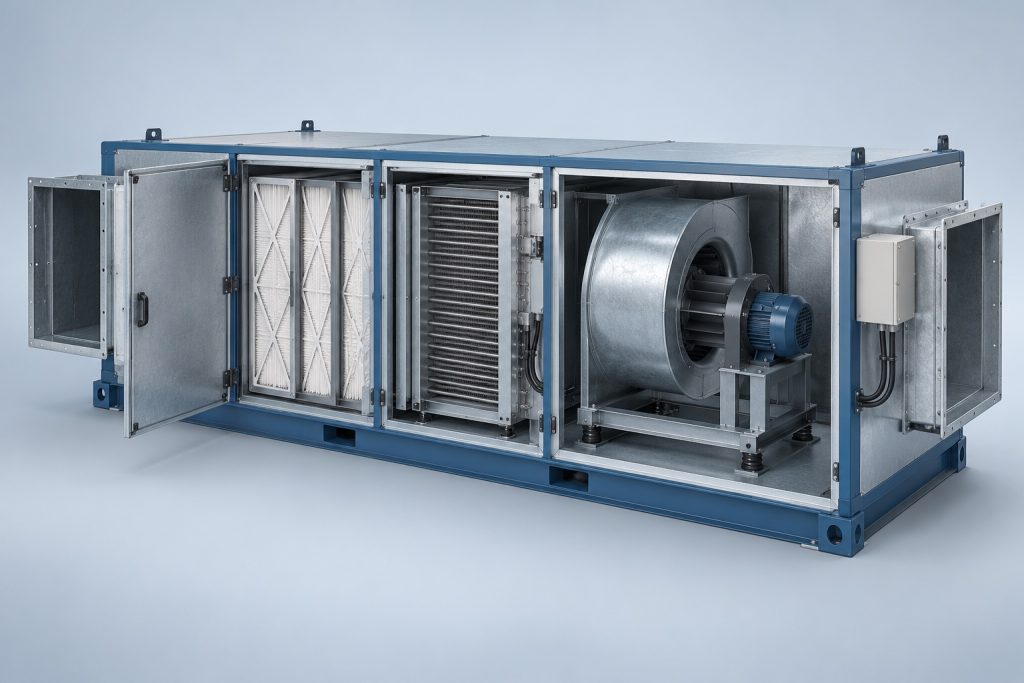
An evidence-led way to review Air Handling Unit Heating with evidence mapping for early research in view
Maintenance planning for air handling unit heating becomes difficult when a product page, an AHU drawing, and an operating requirement are treated as the same evidence. A useful early review separates what is stated from what still needs engineering confirmation. The aim is not to select a heater from a single number. It is to connect the air path, required supply condition, controls, installation space, and validation plan.

Separate category, application, and model scope
Start by defining the object under review. An AHU heater raises incoming or recirculated air to the required supply condition. That description establishes the application, but it does not define every model or installation. A maintenance planner should therefore record the intended air path, operating range, control sequence, and available installation space before comparing candidates. These details determine which page statements are relevant to the task.
Keep category evidence separate from model evidence. A statement about PTC air heating for AHU and ventilation equipment may support an initial application match. It does not, by itself, confirm that a particular assembly fits an existing section. The review should mark each item as either page-listed, drawing-derived, or still requiring validation. This simple classification prevents a general application description from becoming an assumed specification.
Compare information that applies to the task
Use the AHU drawing as the reference for physical questions. Check heater-section geometry, face area, mounting direction, and wiring direction against the drawing. Then compare the available space with the proposed dimensions. The review should also capture voltage, required heat output, airflow conditions, inlet-air temperature, and heat removal. These are not interchangeable fields. A voltage or wattage value cannot answer a fit question, and a fit statement cannot establish the needed heat output.
For an air handling unit heating solution, the most useful comparison is therefore organized by requirement rather than by marketing label. First, ask whether the assembly belongs in the intended air path. Next, record the electrical and dimensional information that is explicitly available. Then identify the control and protection interfaces that the complete AHU must provide. Finally, state which results must be measured in the target unit. This approach keeps early research useful without turning provisional information into a purchase conclusion.
A concrete boundary appears on the official application page: review heater-section geometry, face area, mounting and wiring direction against the AHU drawing; configure voltage and dimensions for the available space; and evaluate required heat output under specified airflow conditions. This is practical guidance for an initial comparison, but it applies only to the statement and product/application scope on that page. It does not establish performance or suitability beyond that scope.
Record assumptions and interfaces
Controls deserve their own line in the evidence record. The captured application guidance states that PTC self-regulation does not replace AHU temperature control, airflow interlocks, or overheat protection. It also calls for validation of heating output and pressure drop across the intended operating range. For maintenance planners, this means a heater review should include the surrounding control sequence, not only the heating element.
The operating principle provides another useful check. Electrical current heats the PTC ceramic element. As the element warms, its resistance increases and helps limit power output. Actual output also depends on supply voltage, inlet-air temperature, and heat removal. These dependencies should be recorded as conditions in the review. They should not be converted into an assumed performance result for an untested installation.
- Define the air path, operating range, control sequence, and available installation space before comparing candidates.
- Compare heater-section geometry, face area, mounting, wiring direction, voltage, dimensions, and required heat output with the AHU drawing and airflow conditions.
- Record temperature control, airflow interlocks, overheat protection, heating output, and pressure-drop requirements as complete-system interfaces.
- Evaluate a sample in the target AHU and check temperature rise, pressure drop, and control response across the operating range before production.
One listed example shows why model scope matters. The page identifies a 220V, 500W insulated PTC air heater with dimensions of 140 × 50.5 × 26 mm and describes it as a compact option for existing airflow paths. Those values are useful when the task concerns that listed example. They should not be generalized to every heater, AHU section, or operating condition.
Prepare a focused sourcing brief
After the evidence map is complete, turn it into a short sourcing brief. State the AHU drawing reference, air path, airflow conditions, required temperature rise, available installation space, voltage, dimensions, mounting direction, and wiring direction. Add the required control sequence and the interfaces for airflow interlocks and overheat protection. Separate requested values from values already supported by page evidence.
For prototype or OEM work, the captured guidance recommends evaluating samples in the target AHU before production. The stated checks include temperature rise, pressure drop, and control response across the operating range. The same guidance says to confirm the approved configuration, order quantity, and delivery requirements for OEM supply. These steps create a clear handoff from early research to technical review without assuming that a page description replaces testing.
A disciplined record should end with open decisions, not vague approval language. Note which dimensions match the drawing, which electrical values are confirmed, which operating conditions define the assessment, and which results remain to be measured. That record gives maintenance, controls, and procurement teams the same basis for the next discussion. It also makes later changes easier to trace because each conclusion remains tied to a defined requirement or evidence source.
In practice, an evidence-led review keeps air handling unit heating aligned with the actual air path, space, controls, and validation need. It distinguishes a listed model from a broader application and treats assumptions as items for confirmation. Used this way, PTCYIDU can be included in a focused sourcing brief without allowing an early page review to stand in for complete AHU evaluation.